Artificial intelligence in healthcare: turning innovation into better care
Discover how Artificial Intelligence is shaping the future of healthcare in South Africa, from improving efficiency and diagnostics to supporting ethical, patient-centred care.
AI in South African Healthcare: From Possibility to Practical Progress
Healthcare is evolving at pace, and Artificial Intelligence is no longer a distant concept reserved for the world of technology. It is becoming a practical tool that can help healthcare systems respond to rising demand, improve efficiency, and support better outcomes for patients. For South Africa, where the health sector continues to face pressure from workforce shortages, growing patient needs, and uneven access to care, AI presents both a significant opportunity and a serious responsibility.
At the Board of Healthcare Funders 2026 Conference, conversations around the data advantage, innovation, trust, and future-fit healthcare systems reflected a clear reality: the sector must think differently about how it delivers care in a rapidly changing environment. Artificial Intelligence sits at the centre of that discussion. When used thoughtfully, it can help strengthen clinical decision-making, streamline administration, and improve the use of limited resources. But its value will depend on whether it is implemented in ways that are ethical, inclusive, and locally relevant.

AI as a Healthcare Enabler
There is often a tendency to frame Artificial Intelligence as a replacement for human expertise. In healthcare, that framing is misleading. AI is not here to replace doctors, dentists, nurses, or other healthcare professionals. It is here to support them.
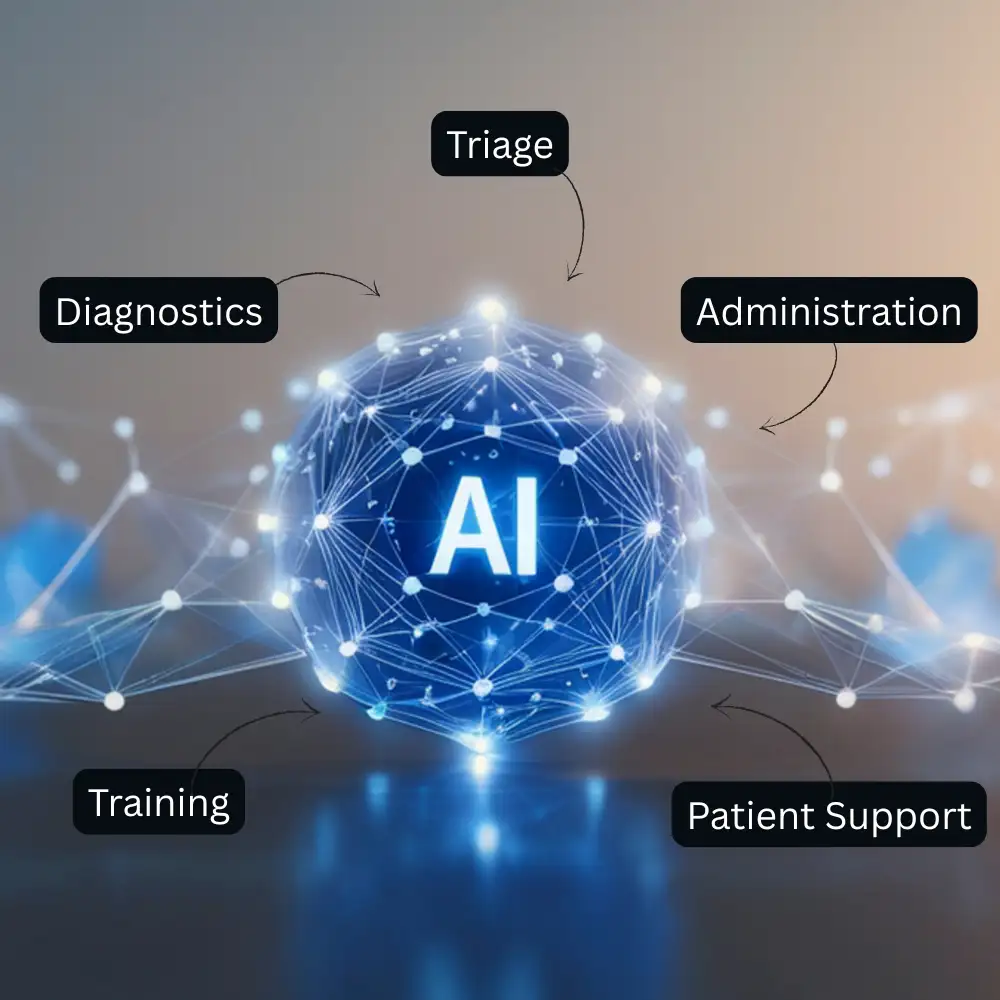
Used well, AI can help analyse data faster, identify patterns earlier, and reduce the administrative burden that so often takes time away from patient care. In practical terms, AI can support imaging interpretation, risk prediction, patient triage, workflow management, clinical documentation, and medical training. South African research has highlighted these same possibilities, pointing to improvements in diagnostics, personalised treatment, data clerking, and overall healthcare organisation.
This matters because every minute saved on repetitive tasks is a minute that can be redirected to the human side of healthcare: listening, diagnosing, reassuring, and treating. In a system where time, capacity, and specialist access are often limited, that is not a small benefit. It is a meaningful shift in how care can be delivered.
The South African context
The case for AI in South African healthcare is compelling, but it cannot be copied and pasted from elsewhere. Our health system operates in a context shaped by inequality, resource constraints, and varying levels of digital readiness. South African studies have noted that disparities in access to technology and education remain real barriers to the adoption of artificial intelligence in healthcare.
This means that the conversation cannot only be about innovation. It must also be about infrastructure, data quality, interoperability, and workforce readiness. If health data is fragmented or incomplete, AI tools may not perform fairly or accurately. If healthcare professionals are not trained to understand and use AI responsibly, the technology may create confusion rather than value. If access is limited to only certain settings, the digital divide may widen instead of narrowing.
For SAMDP, this is an important point. Innovation in healthcare must serve the whole system, not only the most digitally advanced parts of it. That requires solutions that are designed with South African realities in mind, and with the patient experience at the centre.
Trust and ethics matter
As promising as AI may be, the technology also raises legitimate concerns. These include privacy, bias, accountability, and the risk of over-reliance on systems that may not fully reflect local realities. In healthcare, where decisions affect human lives, these concerns cannot be treated as secondary. They must shape how AI is adopted from the beginning.
A responsible AI strategy must include strong governance, clear ethical standards, and human oversight. It should be transparent about how data is used and how decisions are made. It should also ensure that clinicians remain the final decision-makers in patient care. The goal is not automation for its own sake. The goal is better care, delivered more intelligently and more fairly.
This is where trust becomes critical. Patients must have confidence that their information is protected, that technologies are being used appropriately, and that innovation is improving care rather than complicating it. Healthcare professionals must also trust that AI tools are clinically sound, contextually relevant, and designed to support rather than undermine their judgment.

A call for collaboration
The future of AI in healthcare will not be built by one profession or sector alone. It will require collaboration between clinicians, policymakers, researchers, funders, technology partners, and professional associations. South African research consistently points to multisectoral collaboration as the pathway to responsible implementation.
That collaboration should focus on several priorities: investing in digital infrastructure, strengthening local data systems, building digital literacy among healthcare workers, and creating policies that balance innovation with accountability. It should also ensure that the benefits of AI extend beyond urban centres and reach communities where access to care remains uneven.
For SAMDP, this is an opportunity to help shape the conversation. As the healthcare environment changes, our sector must engage actively with innovation while protecting the principles that define good care: professionalism, ethics, equity, and patient-centred service.

Looking ahead
Artificial Intelligence will not solve every challenge in healthcare. It will not replace compassion, clinical judgment, or the trust built between practitioner and patient. But it can become a powerful enabler of better systems, smarter decision-making, and more responsive care.
The question for South African healthcare is not whether AI will become part of the future. The question is how we will use it to strengthen the future we want. If we approach it with purpose, discipline, and integrity, AI can help us build a health system that is more efficient, more inclusive, and better prepared for what lies ahead.
The question is no longer whether AI will enter healthcare, but how responsibly we will use it. For SAMDP, that is a conversation worth leading.